Past art fair · September 4, 2025 – September 7, 2025
Keith Haring Subway Drawings
The Armory Show, New York
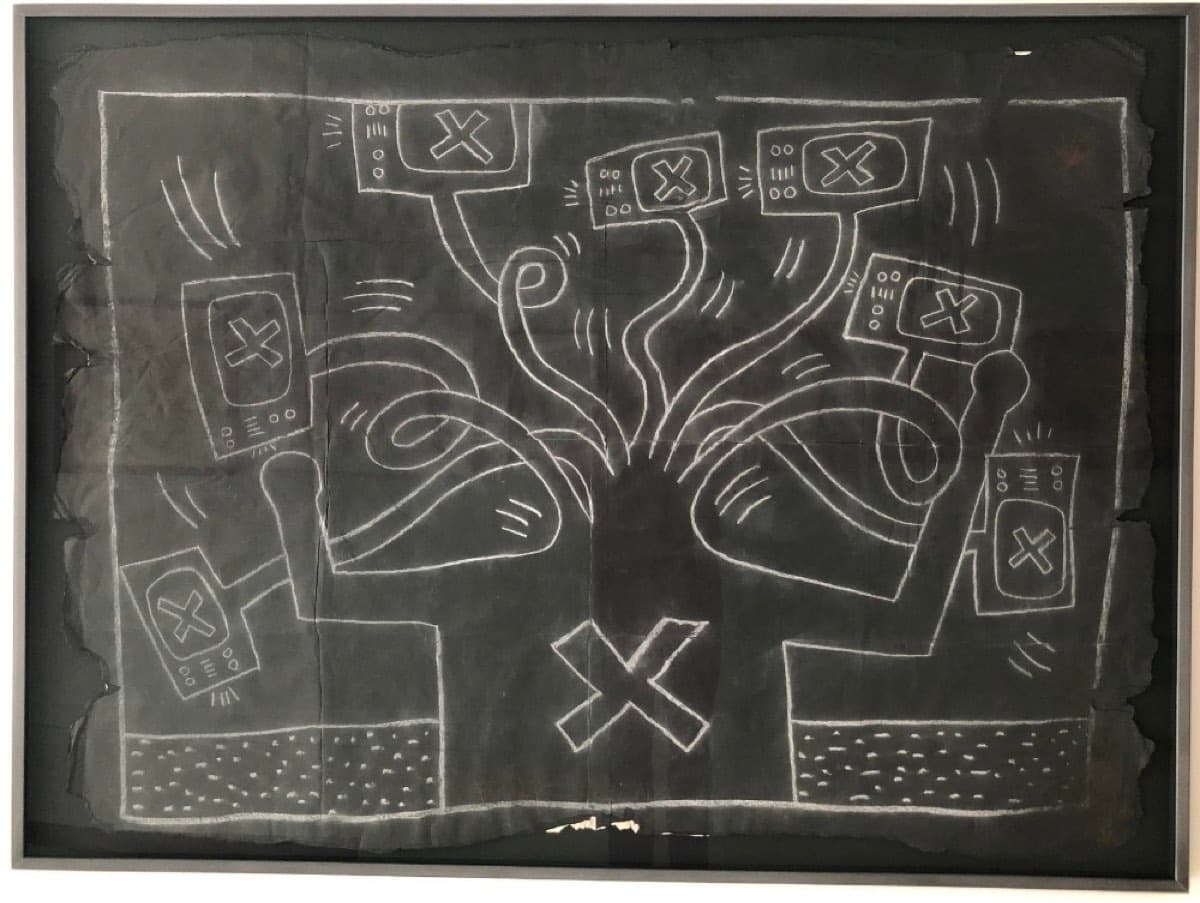
This September, De Buck Gallery participates in the 2025 edition of The Armory Show presenting within its booth a rare and historic group of Keith Haring subway drawings. This special exhibition will feature a selection of iconic works created by Haring in the early 1980s on the New York City subway system—a pivotal moment in both his career and the evolution of street art.
On view will be standout works featuring Haring’s most beloved symbols such as the Radiant Baby, the Barking Dog, and the Three-Eyed Monster, as well as robots, dolphins, and spaceships. Included in the capsule exhibit is an exceptionally rare work still in its original Metropolitan Transit Authority (MTA) frame replete with the advertisement for a 1982 production of Shakespeare in the Park—a particularly exceptional example. The drawing depicts a man riding a barking dog, and a spaceship overhead sending down a beam.
The presentation draws from one of the most significant private collections of Haring’s subway works in the United States and offers a unique window into his radical and democratic approach to public art. Many of the works have appeared in exhibitions including a 2023 show of the subway drawings at the Brattleboro Museum & Art Center, Vermont. A selection of the works are set to appear in the forthcoming exhibition Keith Haring Subway Drawings opening December 7, 2025 at the Rahr-West Art Museum in Wisconsin.
Keith Haring arrived in New York in the late 1970s and was immediately captivated by graffiti art on subway trains. They displayed mastery of drawing, color and scale and maintained a direct connection between the artist and the viewer. For the next few years, Haring’s practice expanded to include video, performance and experiments with text, inspired by William Burroughs and his study of semiotics.
“In much the same way as Chinese or Egyptian languages are written pictographically, Keith Haring’s world is made up of symbols that speak urgently to us, both alone and in interchangeable configurations,” wrote Henry Geldzahler in the introduction to Haring’s book, Art in Transit: Subway Drawings (Harmony Books, 1984). “And as the pictographs or hieroglyphs communicate visually, soundlessly, so too are Haring’s symbols swathed in silence. An eerie quietude surrounds all his work, heightening and animating the dramas they depict.”
By 1980, he returned to drawing with a renewed sense of purpose: to create art for the people. He believed that art only truly lived through the experience of its audience—that its power came from imagination, invention, and confrontation.
His breakthrough came when he noticed a blank black advertising panel in the Times Square subway station—left in place when no ad was available. He bought chalk, returned, and created his first subway drawing. This quickly turned into a daily practice during his commute.
At first a hobby, the drawings soon became a responsibility as more people began to respond positively. Encouraged by strangers who wished him well, Haring felt driven to continue.
“The images are part of the collective consciousness of modern man,” wrote Haring in Art in Transit . “Sometimes they stem from world events, sometimes from ideas about technology or people changing roles in relation to God and evolution. All of the drawings use images that are universally ‘readable.’”
Due to the impermanent nature of chalk on temporary subway panels, his work walked the line between graffiti and public art. Although technically illegal, the ephemeral materials made it hard to define as vandalism. Haring had frequent encounters with the police—ranging from receiving tickets to being handcuffed and detained. Ironically, many officers ended up appreciating his work, and some even expressed excitement at meeting him.
Despite rising success in the mainstream art world, Haring continued to draw in the subway for three years. He considered it his favorite place to work. The subway’s authenticity and its diverse population made it a unique environment—one where people of all backgrounds came together for a shared purpose. In that context, he believed, a gesture of hope or beauty carried its greatest power.
Julia Gruen,the executive director of the Keith Haring Foundation said, “He put all his experience of the world into his art — in the hope that he could communicate at both a visceral and intellectual level with the broadest possible audience.”
Founded in 2010, De Buck Gallery is a global art advisory and contemporary gallery representing influential artists and estates. With a commitment to museum-quality presentations and collector-focused programming, the gallery has developed a strong reputation for championing significant historical works and contemporary voices alike.
Keith Haring (1958–1990) emerged in the New York downtown scene of the 1980s, creating art that blended street culture with high art and carried powerful social messages. His instantly recognizable visual language—bold lines, vivid colors, and iconic figures—made him one of the most influential artists of his generation.
The post Keith Haring Subway Drawings appeared first on De Buck Gallery .